Featured image by Colton Vond. Follow for more of this artist’s work.
For all the flash and flare that a dystopian cyberpunk world seems to get, the reality is that the descent into dystopia is both sudden and subtle. The banning of a president while still in office, the purging of social media accounts for the terrible violation of going against popular thought, advocacy for the expulsion of elected representatives, the downplaying of requests for military intervention by the Speaker of the House.
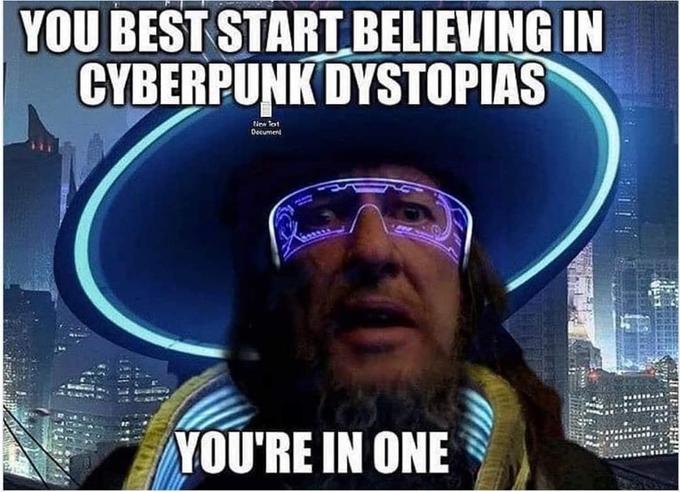
The world has advanced so rapidly, our use of technology helping us span the globe in an instant, revolutionizing food, trade, commerce, business, communications, warfare, medicine, and creating in its wake an entirely new set of problems that we have not yet adapted to: Globalization, climate change, industrial caste systems, medicine-resistant super strains of bacteria and viruses, the revitalization of slavery and pseudo-slavery in mass production. We have grown far faster than our laws have, leaving us in the eddy of chaos and uncertainty that such advances inevitably cause.
Last year, it seemed like everything that encapsulated our largess has come home to roost in the worst of ways. Our consumption culture has resulted in a couple huge problems, and a myriad of smaller ones. In order to keep this huge machine of commerce moving, people must consume, and in order to consume people must have the incentive to consume. This drive to have the newest, latest, greatest, biggest, brightest, and most up to date thing is a huge blessing and a huge curse. We no longer care for tradition, we displace it as easily as last years fashions. Our cars are meant to be replaced every five years or so, our computers as often, our cell phones every year or less.
The pandemic has also increased our appetite for disposable things, single use items that must be discarded after becoming unclean. Our landfills are filling up faster than we can manage, and our oceans are becoming more and more filled with garbage. And yet, we have become so normalized to this new reality, have accepted it, and call it progress. Sure, it’s progress, but it’s not an improvement. Humans weren’t evolved for this kind of life. We didn’t develop as singular hunters. We are a pack animal, forming communities of belonging to satisfy our needs for acceptance, socialization, and safety. Technology isn’t a replacement for those needs, it is a tool that gives us the illusion of connection.
I love to give people hugs and high fives, cardinal sins in the age of COVID. I hope that someday I can get back to my high-five quests, another venture I have where I traveled, usually around Disneyland, giving back to the people employed there. Of course, with the closure of the park in California (temporarily, I hope) I am unable to do so. But I have joked that “huggers aren’t okay” in this pandemic. And in a way I am right. People who desire physical closeness are being adversely impacted from all the required social distancing.
The question becomes how do we get out of it, or what do we do to “fix” it. Those are tough answers with no easy outcome. A lot of people over the next few years are going to be impacted, my fear is that many will die as we reset our baseline and try to live within our planet’s limits. But there are some things that we can do that should help.
We need to relearn what it is to be human. That comes from connecting back to people in real-time and in real life. Putting away the technology, turning off the TV, going outside, making music in person, and having real world experiences. Socializing with friends away from technology. One of the things I am most grateful for is discovering a local game shop and reigniting my love for board games and table top RPGs like Dungeons and Dragons. Connecting with people online is all well and good, but life is so much better in person.
We need to relearn to be self-dependent, to not lay our needs at the feet of others, and to recognize our own faults and flaws. Having to admit our problems to ourselves is more difficult and far less rewarding than blaming someone else, because not only does that make you responsible for your problems, but also makes you the only one capable of fixing them. This country used to have that sense of rugged individualism, and looked down with shame at the notion of getting government assistance. We would rather have died than depend on the government, we should get back to that again.
We need to rediscover the value of physical labor, and reconnect with the earth. We have been disconnected from it for too long. We see life through the windows of our phones, and not with our own eyes.
We need to relearn to be critical and skeptical again. Of what we believe, of what others say, of what our government and businesses tell us. We need to relearn ethics, logic, reason, and to relearn the skills that cultivated our love for the world and our desire to learn about it.
We need to relearn that compassion, empathy, and acceptance starts within ourselves, and can never be forced upon someone else. We cannot impose our will without seeding resentment, regardless of how much we believe in the righteousness of our cause.
There is so much more to get into, it boggles the mind. It seems overwhelming at times, but, like the many times I look at seemingly overwhelming problems, I can break it down brick by brick, until, at last, the way forward is revealed.

 A Place 4Politics